There is a particular feeling every rider knows: you are sitting on a horse that is perfectly capable, in an arena you have schooled in a hundred times, and yet something tightens in your chest. Your leg stiffens. Your breath goes shallow. The horse, reading you like a first edition, begins to mirror exactly what you were hoping to hide. Confidence in the saddle is not simply a matter of hours logged or rosettes pinned to the wall. It is a living quality — one that can be nurtured, lost, rebuilt, and refined at every stage of a riding life.
Whether you are returning to the saddle after a break, working through the aftermath of a fall, or simply trying to ride with the quiet authority your horse deserves, this guide covers the practical, psychological, and physical strategies that genuinely move the needle.
Understanding What Riding Confidence Actually Is
Confidence is often mistaken for fearlessness. It is not. Fearlessness in an equestrian context is, frankly, a liability — horses are large, powerful, and unpredictable, and a healthy respect for that reality keeps you observant and safe. True riding confidence is something more nuanced: it is the belief that you have the resources — physical, mental, and technical — to handle what arises.
Sport psychologists describe this as self-efficacy: your internal assessment of your own capability in a specific domain. The important word is specific. You can have high self-efficacy at rising trot on a schoolmaster and low self-efficacy cantering a young horse on a windy day. This is not inconsistency; it is honest calibration. Recognising where your confidence sits on a granular level — rather than treating it as a single dial labelled "confident" or "not confident" — is the first step towards changing it.
The British Horse Society has long emphasised that rider confidence forms a cornerstone of safe and effective horsemanship, and it is a theme that runs through every level of their coaching qualifications. Their guidance makes clear that addressing confidence is not a soft afterthought to technical training; it is part of the technical training itself.
The Horse–Rider Feedback Loop
Before you can build confidence, it helps to understand why it erodes so quickly around horses. Unlike most sports, riding involves a second sentient being — one with a nervous system finely tuned over millions of years to detect predator-level threat signals. Tension in your hip flexors, a held breath, a braced lower back: your horse registers all of it before your conscious mind has fully processed what you are feeling.
This creates a feedback loop that can spiral in either direction. When you are relaxed and breathing, your horse relaxes. When you tighten, your horse becomes alert. When your horse becomes alert, you tighten further. Breaking this cycle requires you to work on your own physiology as deliberately as you work on your position.
Practical intervention: Diaphragmatic breathing — breathing into the belly rather than the chest — activates the parasympathetic nervous system and measurably lowers heart rate. Before you mount, take three slow, deliberate breaths. During a tense moment in the school, exhale audibly. You will often feel your horse's back soften within a stride or two. It is one of the most immediate tools available to any rider, and it costs nothing.
Building Confidence Through Progressive Schooling
Confidence grows when you are consistently working at the edge of your current ability — not beyond it. This principle, well established in performance psychology, means that the most effective schooling plan is one designed around progressive overload: each session slightly more demanding than the last, but never so far outside your comfort zone that anxiety floods the system.
If you are newer to riding and building your foundation, the beginner's guide to how to ride a horse on this journal offers a useful grounding in the early technical skills that underpin everything else. Solid basics — an independent seat, following hands, consistent leg — are not just about correctness. They are the infrastructure on which confidence is built. When your body knows what to do without conscious deliberation, your mind is free to think, adapt, and trust.
A few principles worth carrying into every session:
- End on a good note. This is not merely a cliché. Finishing a session with something your horse does well consolidates a positive association for both of you.
- Name what went well. After dismounting, identify at least one thing that worked. The brain's negativity bias means it will naturally catalogue the errors; you have to consciously balance the ledger.
- Make your goals specific and small. "Ride a good canter" is too vague to generate confidence. "Maintain a soft contact through the canter transition on the left rein" gives you something measurable to succeed at.
The Role of a Good Coach
No amount of self-help literature replaces a pair of educated eyes on the ground. A qualified instructor does not simply correct your position — they calibrate the difficulty of your work to your current state, push you when you are ready, and pull back when anxiety is getting in the way of learning. They are, in a very real sense, confidence architects.
Look for a coach who creates a psychologically safe environment — one where questions are welcomed, mistakes are treated as information rather than failures, and the session pace is responsive to how you are actually feeling on a given day, not just what the lesson plan says. The British Equestrian Federation, through British Equestrian, provides resources on finding accredited coaches and outlines the standards you should expect.
If you are working through significant anxiety — particularly after a fall or a frightening incident — it is worth knowing that some coaches specialise in exactly this area, and that sports psychology support is increasingly available and normalised within equestrian sport at every level.
Mindset, Ritual, and the Objects Around Your Riding
The mental preparation that happens before you reach the mounting block matters more than most riders acknowledge. Elite athletes across disciplines use pre-performance routines — specific sequences of thought and action — to shift themselves into an optimal mental state. You can build your own.
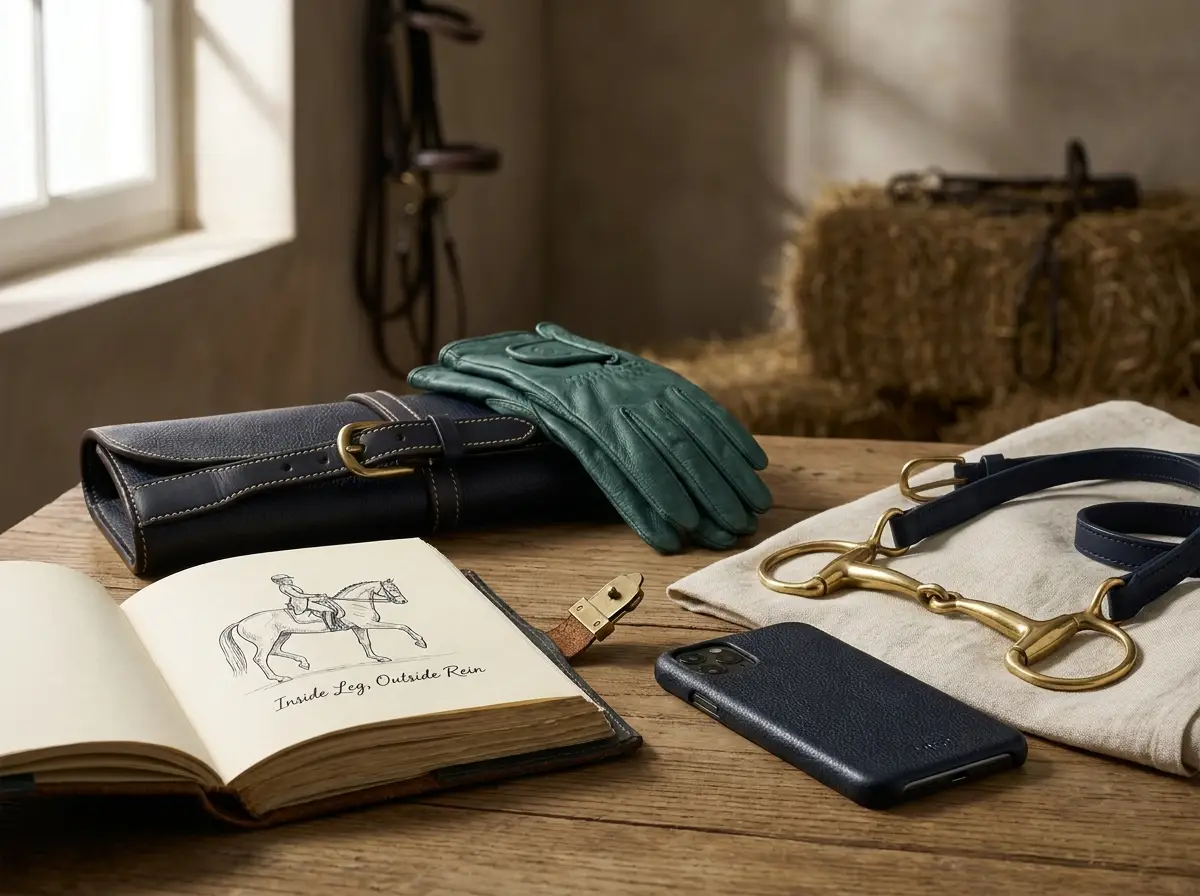
This might include arriving at the yard with enough time not to feel rushed, grooming your horse with genuine attention rather than functional efficiency, or carrying a small, intentional reminder of why you ride. Words have particular power here. Many riders find that a short phrase — a personal motto, a line from a mentor, a commitment to themselves — can anchor focus in moments of doubt. It is this idea that sits at the heart of our Rider's Motto collection: handcrafted, full-grain leather iPhone cases bearing the kind of words riders carry in their heads and hearts. The object you reach for between sessions can quietly reinforce the identity you are building in the saddle.
If you want something entirely personal — a phrase that belongs only to you, perhaps words your trainer once said that changed everything — the custom option allows you to bring that to life in leather. It is a small thing, perhaps, but the rituals and objects that surround a pursuit shape how we show up for it.
Processing Setbacks and Falls
Falls are, for most riders, inevitable. The British Horse Society recommends always wearing an appropriate standard hat and body protector precisely because the sport carries inherent risk that cannot be entirely designed away. Accepting this — not fatalistically, but honestly — is part of developing a mature equestrian mindset.
What separates riders who rebuild quickly from those who stay stuck is rarely bravery. It is how they narrate the event to themselves. A fall that becomes "I am not safe on horses" is a story that closes doors. A fall that becomes "that was frightening, and I now know something specific I need to work on" is a story that opens them. This reframing is not denial; it is accurate. Almost every fall has a technical or situational cause that can be examined and addressed.
Returning to riding after a fall should be gradual and deliberate — on a reliable horse, in a familiar environment, with your instructor present. The nervous system needs repeated evidence of safety before it will release the threat response it has associated with riding. Give it that evidence, one calm session at a time.
Sustaining Confidence Over the Long Term
Confidence is not a destination. Even riders at the highest levels — those competing at international championships — describe ongoing work on their mental game. The difference between a beginner and an elite is not that the elite no longer has doubt; it is that they have developed a more sophisticated relationship with it.
Sustainable riding confidence rests on a few long-term habits:
- Consistent, quality instruction — not necessarily frequent, but regular enough to keep your technical foundation honest.
- An honest relationship with your horse's wellbeing. A horse that is comfortable in its body and clear in its training is a more trustworthy partner. Regular veterinary and physiotherapy assessment, alongside thoughtful schooling, protects both of you.
- A community that normalises the struggle. Riding with or alongside others who are also working on their confidence — and who talk about it openly — removes the isolation that anxiety feeds on.
- Written reflection. A brief riding journal, even just a few lines after each session, builds a body of evidence that you are progressing. On difficult days, it is there to remind you of the distance you have already travelled.
The horse does not care about your CV, your competitive record, or the number of years you have been riding. It cares about the quality of your presence in this moment. Building confidence in the saddle is, in the end, the practice of learning to be genuinely present — steady in your body, clear in your intention, and honest about where you are. That is a practice worth returning to, every single ride.