There is a particular kind of frustration that every rider knows: the feeling of having ridden beautifully on a Tuesday, only to arrive on Thursday and find the whole thing has evaporated. The half-halt that finally clicked, the moment your outside rein truly connected, the precise angle at which your horse softened through his back — gone, or at least hidden somewhere beneath the noise of a new day. A training journal is the simplest, most reliable remedy for that experience, and yet it remains one of the most consistently overlooked tools in equestrian development.
This is not about keeping a diary. It is about building a living record of your partnership, your progress, and your thinking — a document that works quietly on your behalf between every ride.
What a Training Journal Actually Does
At its most practical, a journal externalises your memory. Human recall is reconstructive rather than reproductive; we do not play back experiences like recordings. We rebuild them, and in rebuilding, we edit — smoothing over what was awkward, softening what was discouraging, and, crucially, losing the fine-grained sensory detail that actually teaches us something.
Writing an entry immediately after dismounting forces you to articulate what happened with a specificity that thinking alone rarely demands. My left shoulder dropped every time we approached the corner on the right rein is actionable. It was a bit uneven is not. That precision is the difference between a vague sense of something being off and a pattern you can actually address.
The British Horse Society has long emphasised the importance of progressive, reflective training for both horse and rider development — the kind of incremental, considered approach that a journal naturally supports. When you read back over three months of entries, the arc of your development becomes visible in a way that is simply impossible to perceive from inside a single session.
The Trainer's Voice Between Sessions
If you work with a coach, a journal is the most effective way to extend the value of your lessons. A good trainer will give you several things to work on in a single session — corrections, exercises, imagery, adjustments to your position or timing. By the time you are back in the saddle two or three days later, the average rider retains perhaps one or two of those points clearly. The rest has blurred.
Writing up your lesson notes — even a rough list of your trainer's key phrases — gives you a reference document for every subsequent schooling session. You are, in effect, keeping your trainer in the arena with you when they are not there.
This is particularly valuable for riders who are building foundational skills. If you are working through the early stages of your riding education, revisiting the core principles covered in something like our beginner's guide to riding a horse alongside your own journal entries creates a feedback loop between theory and lived experience that accelerates understanding considerably.
Journalling Your Horse, Not Just Yourself
The most sophisticated training journals track two subjects simultaneously: you, and your horse. This distinction matters enormously, and it is one that less experienced riders sometimes miss.
Your horse is not a constant. His energy, suppleness, responsiveness, and mood vary from day to day, influenced by everything from the weather and his turnout time to the phase of his season, his diet, and his workload. A journal that notes his behaviour, way of going, and any physical observations alongside your own riding creates a longitudinal picture of his wellbeing that is deeply useful — and occasionally critical.
Patterns that emerge over weeks of entries — a consistent stiffness on the left rein on cold mornings, an unusual reluctance to engage in collected work, a change in his willingness to load — can prompt timely conversations with your vet or physiotherapist. The World Horse Welfare organisation consistently highlights the importance of attentive, ongoing observation in equine care; a journal is a structured way to make that observation habitual and retrievable.
Noting your horse's responses also deepens your empathy for him. When you write he was distracted and tight today; the mares were being moved in the adjacent field rather than simply bad session, you are practising the interpretive generosity that distinguishes a true horseperson from someone merely riding a horse.
The Confidence Archive
Here is the use of a journal that riders rarely anticipate until they need it most: on a genuinely difficult day — after a fall, before a competition that has grown in your mind to enormous proportions, or during one of those dispiriting plateaus where nothing seems to improve — your own past entries become some of the most powerful evidence available to you.
Anxiety has a particular quality when it comes to riding. It tends to collapse time, making it feel as though you have always struggled and always will. A journal dismantles that illusion with specificity. There, in your own handwriting, is the entry from six months ago where you wrote that you could not canter a circle without falling out through the outside shoulder. And here you are now, doing it without thinking. The progress was real. The journal proves it.
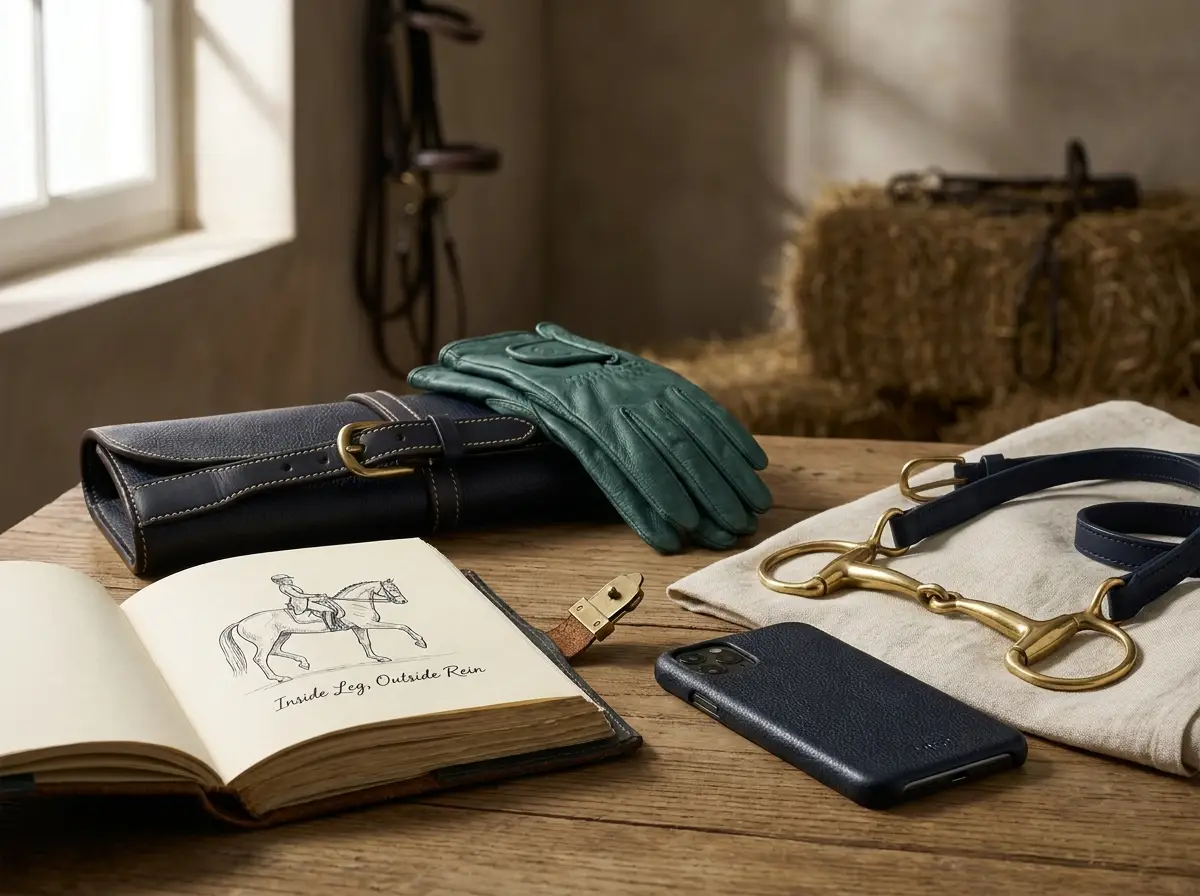
This is the spirit behind our Rider's Motto collection — pieces personalised with the words, phrases, or maxims that anchor a rider's mindset. A motto carried in your pocket or on your phone case is the distilled version of what a journal does at length: it reminds you who you are and what you stand for when the pressure is on. The two practices complement each other naturally.
How to Structure an Entry That Actually Works
The temptation when starting a journal is to over-engineer the format. A complex template with multiple scored categories sounds thorough; in practice, it becomes a reason not to write. Keep the structure minimal and consistent.
A reliable entry covers four things:
- What you worked on — the exercises, movements, or focus of the session.
- What went well — however small. Training without acknowledgement of progress is demoralising and incomplete.
- What needs attention — one or two specific things to carry forward, not an exhaustive critique.
- Your horse's state — energy, mood, any physical observations worth noting.
Some riders add a fifth element: a word or phrase to carry into the next session. This might be an image your trainer used (think of lifting him, not pulling him back), a physical sensation you want to recreate (that moment when my hips finally followed his walk), or simply a single word — patience, forward, breathe. This is where journalling edges into the territory of performance psychology, and it is more powerful than it sounds.
The Long Game: Reviewing and Using Your Journal
Writing entries is only half the practice. The other half is reading them. A monthly review — even a ten-minute skim — surfaces patterns you would never notice session by session: the exercises that consistently produce your best work, the conditions under which your horse is most receptive, the mental states that correlate with your strongest rides.
Over a full year, a well-kept journal becomes something close to a coaching document in its own right. You will know your horse more intimately than almost any outside observer could. You will understand your own tendencies — the tension habits, the moments of self-doubt, the conditions under which you ride with genuine freedom — with a clarity that transforms how you approach your training.
The Federation Equestre Internationale places considerable emphasis on the development of the educated, self-aware rider as a cornerstone of equestrian sport at every level. A training journal is the most democratic tool available for building exactly that self-awareness — it requires nothing more than a notebook and fifteen minutes of honest attention.
Starting Today: A Practical Note
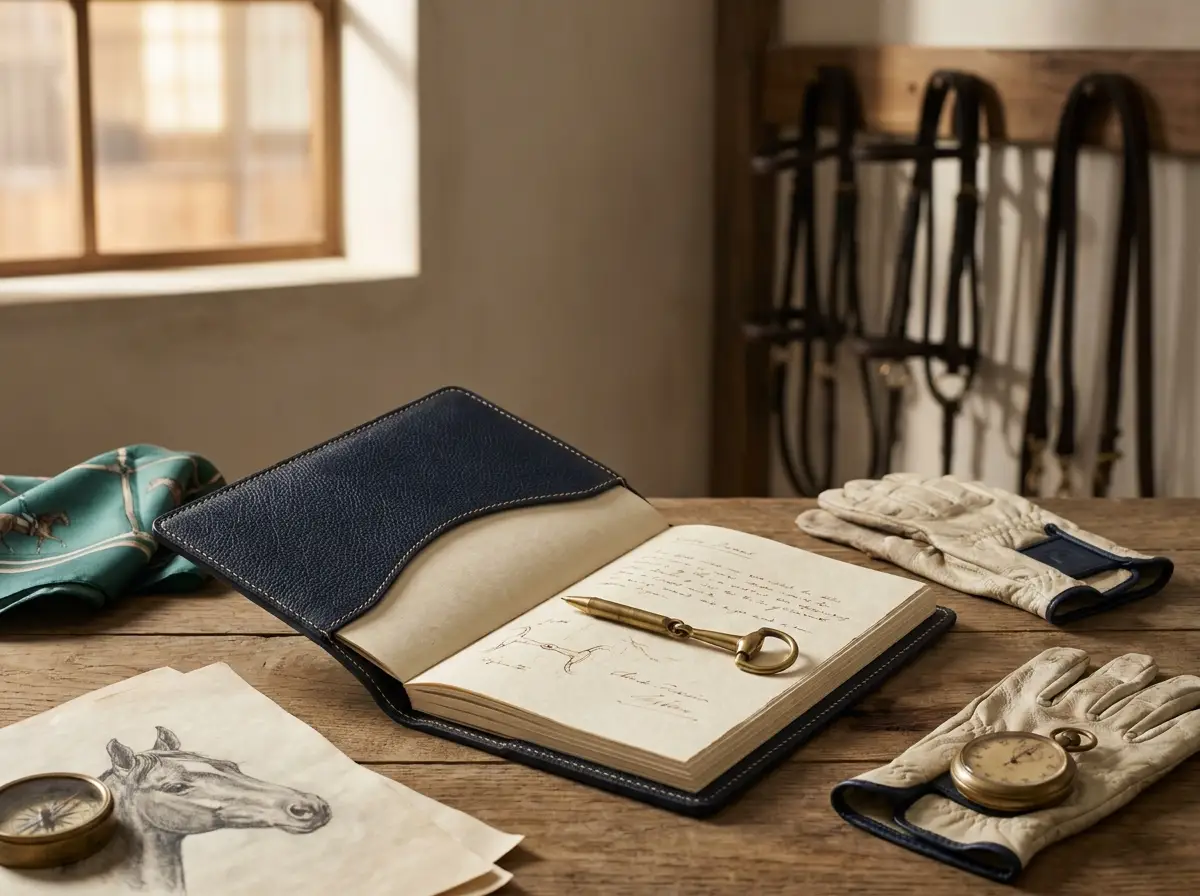
If you have never kept a training journal, the only rule is to begin simply. A plain notebook is enough. Write your first entry tonight, about today's ride or the last one you remember clearly. Do not wait for the perfect format or the ideal moment.
The craft of leather-working offers an instructive parallel here. A full-grain leather piece — whether a bridle, a saddle, or one of our handcrafted cases — develops its character through consistent, accumulated use. The patina that makes aged leather beautiful cannot be rushed or faked; it is the physical record of time and attention. A training journal works in exactly the same way. Its value is not in any single entry but in the whole that accumulates, slowly and honestly, over years of riding.
Begin tonight. Your future self, sitting in the yard before a competition wondering whether you are ready, will be very glad you did.