There is a particular moment every rider remembers: the first time a horse moves beneath you and you feel — truly feel — that this is an animal choosing to carry you rather than simply tolerating the arrangement. Learning how to ride a horse is not merely a physical skill; it is the beginning of a conversation conducted in weight, breath, and stillness. This guide is written for those standing at that threshold, ready to begin.
What "How to Ride a Horse" Actually Means for Beginners
The practical answer to how to ride a horse is this: you learn in stages, always under qualified instruction, always with the horse's welfare and your own safety held in equal regard. You do not simply climb aboard and go. The first lessons happen largely on the ground — learning to read a horse's body language, to approach calmly, to groom and tack up with confidence. The saddle comes later, and speed comes later still. This measured progression is not timidity; it is the foundation upon which everything else is built.
If you are searching for where to begin, the British Horse Society offers internationally recognised qualifications and a yard-finder tool that can help you locate approved riding schools whether you are based in the UK or looking for a benchmark of quality elsewhere in the world.
Finding the Right Riding School and Instructor
Before you ever sit in a saddle, the single most consequential decision you will make is choosing where to learn. A good riding school will have:
- Accreditation or affiliation with a recognised national body (in the US, look for US Equestrian affiliated facilities)
- Horses that are well-fed, well-shod, and visibly relaxed around people
- Instructors who give clear, constructive feedback without raising their voices — at you or the horse
- A structured beginner programme rather than ad hoc lessons
Group lessons versus private lessons is a question worth considering early. Group lessons, which typically cost between $25 and $50 per session in the United States, offer the benefit of watching other riders make and correct the same mistakes you will make. Private lessons, running closer to $50–$100, allow the instructor to focus entirely on your position and progress. Many beginners benefit from beginning with private lessons and transitioning to group work once they have a secure seat.
Once you have found your school, do not rush to buy equipment. Borrow or hire a helmet that meets current safety standards, wear sturdy boots with a small heel, and leave everything else until you know the discipline you wish to pursue.
Understanding Horse Gaits Before You Ride
Horses have four natural gaits, and understanding them intellectually before you feel them beneath you is genuinely useful.
Walk
The walk is a four-beat gait — each hoof strikes the ground separately in a regular 1-2-3-4 rhythm. It feels like a gentle, rolling sway. This is where all beginners begin, and where experienced riders return whenever they are establishing something new.
Trot
The trot is a two-beat diagonal gait: the horse's legs move in diagonal pairs. For the rider, it produces a bouncing motion that must be managed either by sitting (absorbing the movement through a relaxed lower back) or rising — posting up and down in rhythm with the horse's movement. The rising trot is typically the first gait challenge a beginner faces, and it takes most riders several sessions to find the rhythm consistently.
Canter
The canter is a three-beat gait with a characteristic rocking-horse motion. Many beginners find it, once achieved, more comfortable than the trot, because the rhythm is easier to follow. It requires the rider to allow their hips to follow the horse's movement rather than bracing against it.
Gallop
The gallop is the horse's fastest gait — a four-beat extension of the canter. It is not a beginner's gait. Riders are typically introduced to gallop only after they have a genuinely independent seat and are confident at canter.
The Foundations of Good Position
Every experienced rider and every great trainer will tell you the same thing: position is everything. Not because it looks elegant — though it does — but because your position communicates directly to the horse through balance and weight distribution. A rider who is tense, collapsed, or gripping with their knees is sending constant noise through the reins and saddle; a horse cannot ignore this.
The classical beginner's position checklist:
- Heels down — your heel should be the lowest point of your foot in the stirrup, which prevents your foot from slipping through and guards against the leg swinging back
- Eyes up — look between the horse's ears and toward where you are going, not down at the ground
- Shoulders back and relaxed — not military-stiff, but open and not hunched
- Soft hands — the rein contact should feel like holding a small bird: firm enough that it cannot fly away, gentle enough that you do not crush it
- Seat bones in the saddle — you should be sitting on your seat bones, not perched on your tailbone or tipped forward onto your thighs
This is the position you will be correcting and refining for as long as you ride. Even riders with decades of experience return to these fundamentals every single session.
Western Versus English Riding: Which Should You Choose?
If you are learning how to ride a horse western, you will be sitting in a deeper, larger saddle with a prominent horn at the front, using a single rein in each hand (or both reins in one hand as you progress), and working within a tradition rooted in ranch and cattle work. Western riding emphasises a relaxed, following seat and subtle neck-reining communication.
English riding — which encompasses disciplines from dressage to show jumping to eventing — uses a lighter, flatter saddle and maintains a consistent two-handed rein contact. The aids are applied with greater precision and smaller movement.
Neither is easier than the other; they are simply different conversations with the horse. Choose based on what is available locally and what excites you, not on any assumption about difficulty. Many riders eventually explore both.
Practical Questions Every Beginner Asks
How old does a horse have to be to ride?
Most horses are not started under saddle until at least three years old, with many trainers preferring four, particularly for heavier work. A horse's skeletal growth plates are still closing through early life, and premature loading risks lasting damage. If you are ever in doubt about a school horse's soundness or suitability, ask — a reputable yard will welcome the question.
How much can you weigh to ride a horse?
The standard guideline used widely across the equestrian world is that a rider should not exceed 20% of the horse's body weight. A typical middleweight riding school horse weighing around 500 kg (roughly 1,100 lb) can therefore comfortably carry a 100 kg (220 lb) rider. This is not a rigid rule that ignores all other factors — the horse's fitness, conformation, and the nature of the work all matter — but it is a sensible starting point. If you have concerns about how much you weigh to ride a horse, raise them honestly with your instructor; matching rider to horse is part of their professional responsibility.
How hot is too hot to ride a horse?
A widely used field guide among equestrians is the "sum of 150" rule: temperature in Fahrenheit added to relative humidity percentage. Below 130, most horses cope well. Between 130 and 150, reduce intensity and ensure access to water. Above 150, reconsider riding altogether; above 180, the horse's ability to cool through sweating is significantly compromised. Ride in the early morning or evening in summer, and learn to recognise early signs of heat stress — unusually heavy sweating, rapid or laboured breathing, or a horse that seems dull and reluctant to move.
The Mindset Behind the Mechanics
Here is the insight that no beginner's checklist quite captures: horses are extraordinarily sensitive readers of human emotional state. A rider who arrives at the yard anxious, distracted, or impatient will find a horse that mirrors precisely those qualities back at them. The riders who progress fastest are not always the most athletically gifted; they are the ones who develop the capacity to become still — mentally and physically — before they ever ask the horse for anything.
This is where riding intersects with something deeper than sport. Many riders speak of the yard as the one place where the noise of daily life genuinely falls away, because horses demand your full presence. You cannot be half-there.
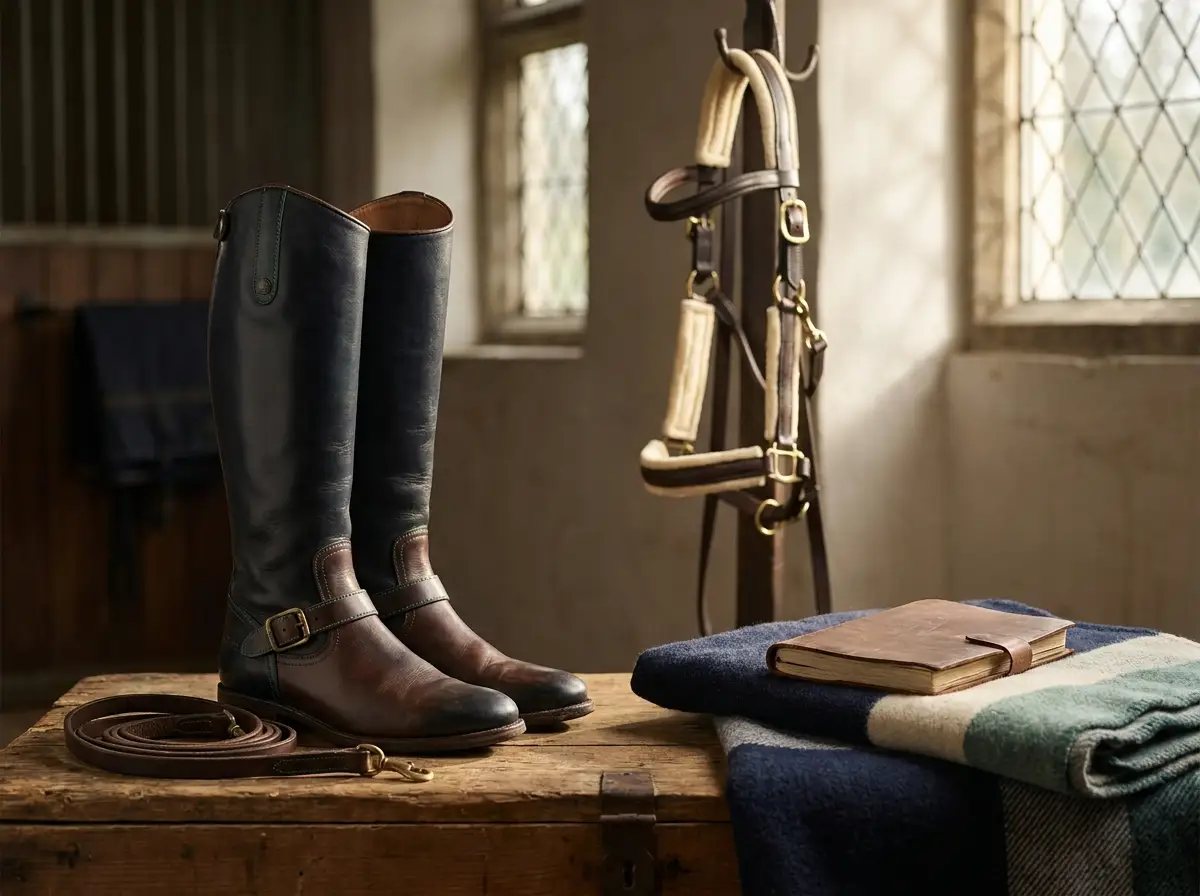
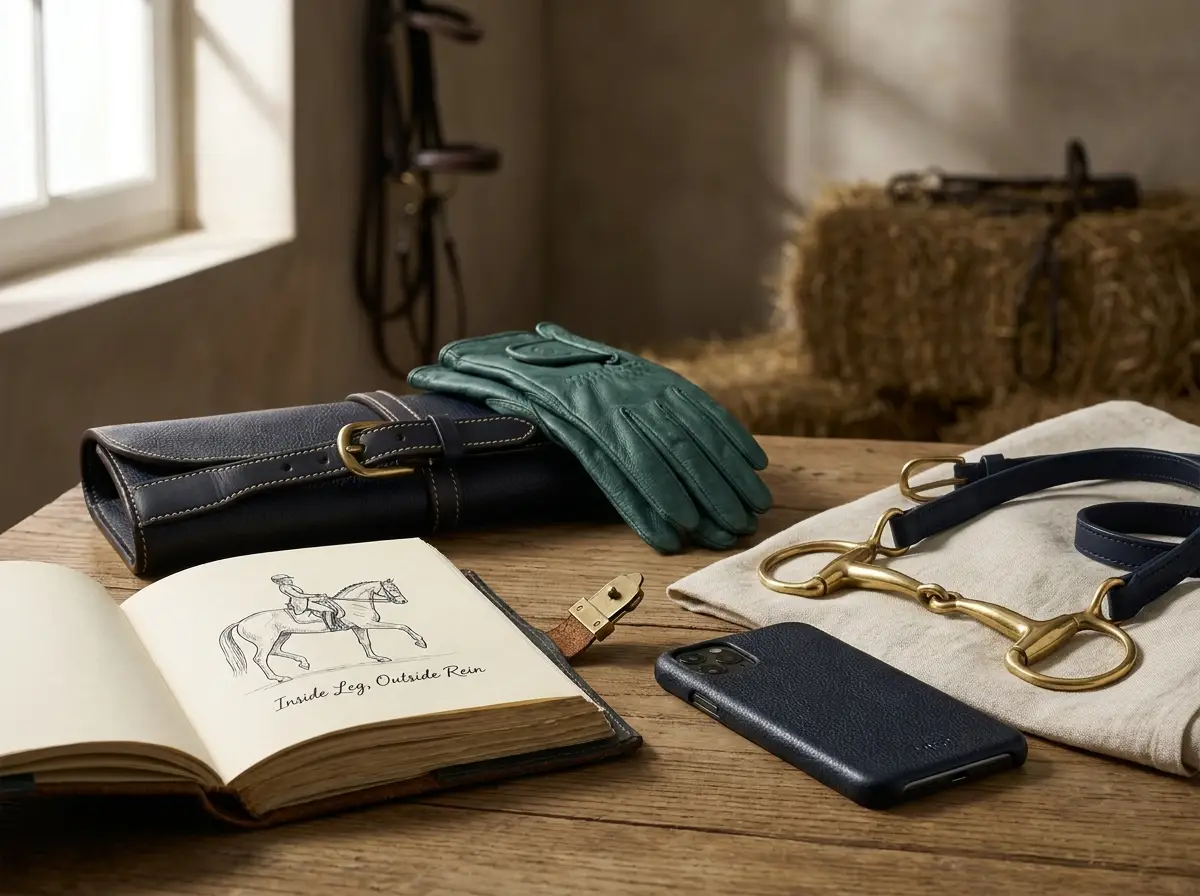
At Velvet & Valor, we find this philosophy expressed in the objects riders carry with them everywhere — the things that hold meaning beyond function. Our Rider's Motto collection, handcrafted in full-grain leather and featuring artist-designed equestrian motifs, is made for the rider who understands that the values practised in the saddle — patience, precision, quiet confidence — do not disappear when the boots come off. If you would like something truly personal, our custom leather cases can be made to carry your own motto, your horse's name, or a design that holds particular meaning to you and your partnership.
For further reading on riding technique, horse care, and the equestrian life, explore The Equestrian Journal.
Building Your First Months in the Saddle
Progress in riding is rarely linear, and this is worth knowing in advance. You will have sessions that feel like a breakthrough — where the rising trot clicks, where the canter transition happens exactly when you asked — and sessions where nothing seems to work and the horse seems to be speaking an entirely different language. Both are normal. Both are productive.
A rough framework for the first six months:
- Lessons 1–4: Ground handling, mounting and dismounting safely, walk on a lead rein or lunge line, basic halt
- Lessons 5–10: Independent walk, introduction to rising trot, learning to steer with confidence
- Lessons 10–20: Rising and sitting trot, introduction to canter on the lunge, beginning to understand diagonal and lead
- Month 3–6: Independent canter, basic schooling figures (circles, transitions), riding out in a small group
These are approximate. Some riders move faster; many take longer, and longer is perfectly fine. The goal is not speed of progression — it is depth of understanding.
One thing the most experienced equestrians will tell you, and that the Reddit threads and beginner tip-lists rarely say plainly: the horse is always teaching you, even when you think you are teaching the horse. Approach every session with that humility, and you will go further than any lesson plan can take you.